Designing Real-Time Voice Agents Around Streaming Audio
Understand the stages in a streaming voice-agent pipeline, from audio capture and model connection to playback and interruption handling.
Voice AI · 2 min read · Kriyvo journal
In this article
Introduction
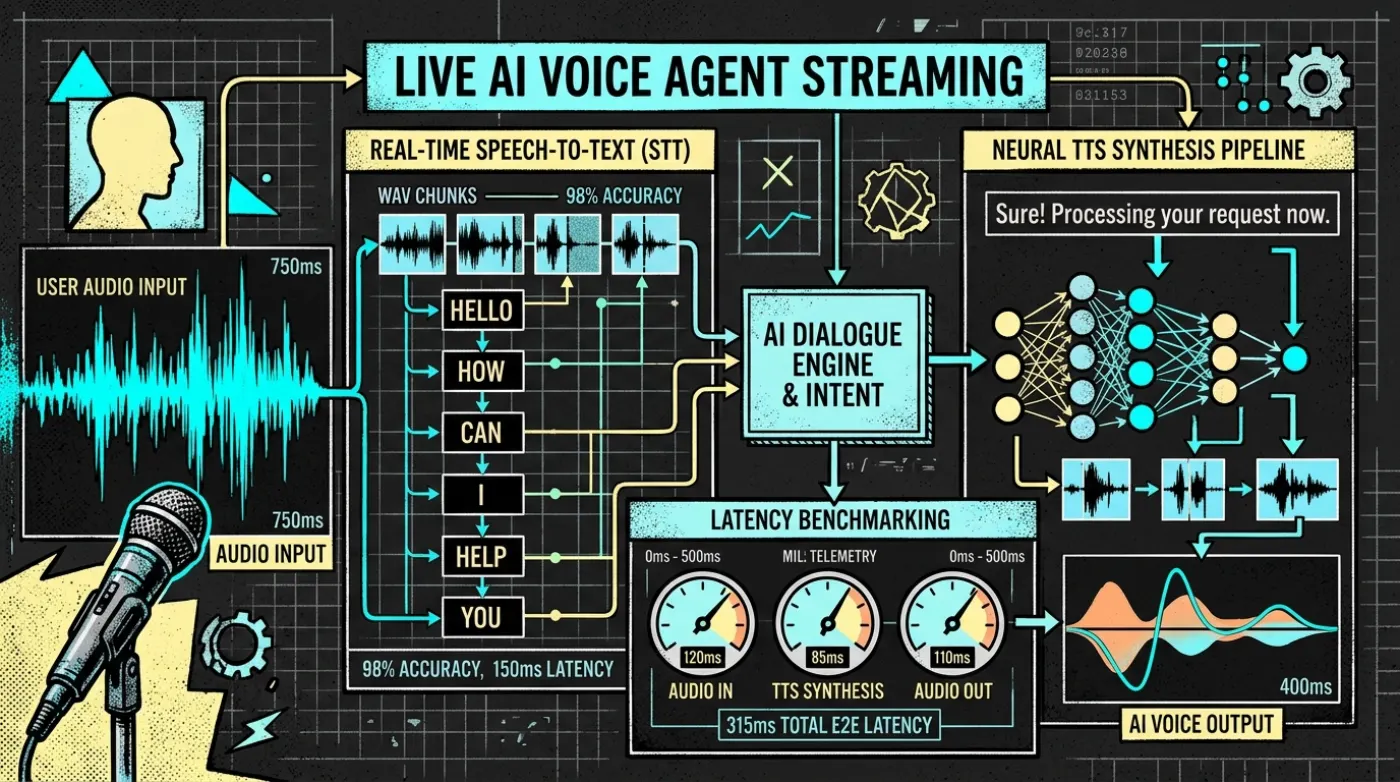
Real-time voice pipeline: chunked STT, intent classification & low-latency neural TTS synthesis
A voice agent feels responsive when it can process and return audio as a conversation unfolds. That requires coordination among audio capture, transport, model processing, playback, and conversational state. A model response alone is only one part of the experience.
Treat it as a reported outcome, not a verified benchmark or a guarantee for another deployment.
Map the audio path
Write down each stage from the user's microphone to returned audio: capture and buffering, connection setup, audio transmission, model processing, response streaming, and playback. This map helps identify where delay or failure can occur and clarifies what the application controls versus what depends on network and provider behavior.
Streaming can let processing begin before a complete recording is available. It also means the application must manage partial turns and connection state instead of assuming each request is one finished file.
Define turn and interruption behavior
Decide how the system knows a user has finished speaking, what happens when speech is unclear, and whether a person can interrupt the agent while it is speaking. If interrupted, the client and server need a consistent way to stop or replace current output so stale audio does not continue playing.
Test on expected devices and networks. A clean microphone recording may not reveal problems caused by background noise, short pauses, packet loss, or a user changing their mind mid-sentence.
Make connection failures understandable
Distinguish listening, processing, speaking, and reconnecting states. Define what the user hears when a connection drops, whether a turn can be safely retried, and how the system avoids responding twice to the same input.
Need this built? LLM and AI agent development
Bounded AI applications and agents using Python, LangGraph, retrieval and controlled API integrations.
See the serviceWritten for the Kriyvo journal. Product claims reported by third-party sources are not independent Kriyvo AI benchmarks.